BIM after handover: Don’t let your expensive model become a digital ruin
This piece is the international version of our recent Chinese article, written after several provincial governments issued guidelines on BIM in operations. These include Xinjiang’s lifecycle BIM notice (in force 1 July), Shanghai’s 2025 BIM Application Guidelines, and parallel moves in Jiangsu, Fujian and Shandong. The core problem, models that are well-built at handover but unused in operations, is not unique to China. We have recast the argument for English-speaking readers here and for similar public and infrastructure projects worldwide. You can read the original article in Chinese here.
BIM is no longer optional on many public and large infrastructure projects. Singapore now requires digital BIM submissions for building approvals. The UAE mandate BIM on large and complex developments. Saudi Arabia treats structured models as standard on Vision 2030 giga-projects. Malaysia is making BIM mandatory on major federal works. Hong Kong applies it to public works. In all of these markets the focus is moving from design and construction into the operations phase, in line with ISO 19650-3. The risk is the same everywhere: a sophisticated model delivered at handover that is never used and quietly becomes a digital ruin.
The value of BIM in operation and maintenance is not flashy 3D visualisation. It is data continuity: a digital twin that actually carries equipment codes, spare-parts lists, procedures, as-built attributes and history so that maintenance teams can use it every day.
What actually keeps the model alive after handover
A well-known industry gap is that design firm or contractor models are built for design and construction, not for O&M. They emphasise geometry, materials and clash detection. They rarely include the asset attributes needed for daily work. They have no user interface suitable for maintenance teams. They often sit behind expensive authoring licences that field staff cannot use. The result is that the model is disconnected from the site the moment the keys are handed over.
Siveco China and its Bluebee Lab, now part of Bluebee Tech, pioneered BIM for O&M as early as 2013. They address this challenge with a pragmatic, management-driven approach developed and proven at scale.
- Data preparation from construction onward. Structured equipment databases (manuals, spare parts, coding, initial maintenance strategies) are built so that as-built information transfers cleanly into the asset register and CMMS. This is digital delivery that operations can actually use, not a file dump that nobody opens again.
- Start from the work order, not from the 3D viewer. Technicians begin with a work order or a failure record and from there reach history, drawings, spare-parts data and, when useful, the 3D model to locate equipment, confirm isolation steps and prepare the job. The model is a helper for the maintenance task. It is not the system technicians live in every day.
- Lightweight integration. Full native BIM models are often too heavy for daily O&M. A thin maintenance data layer on top of the model, or a structured import into the CMMS through standard interfaces, keeps response times fast and hardware requirements modest. This has been validated on office buildings, process plants, water and waste facilities.
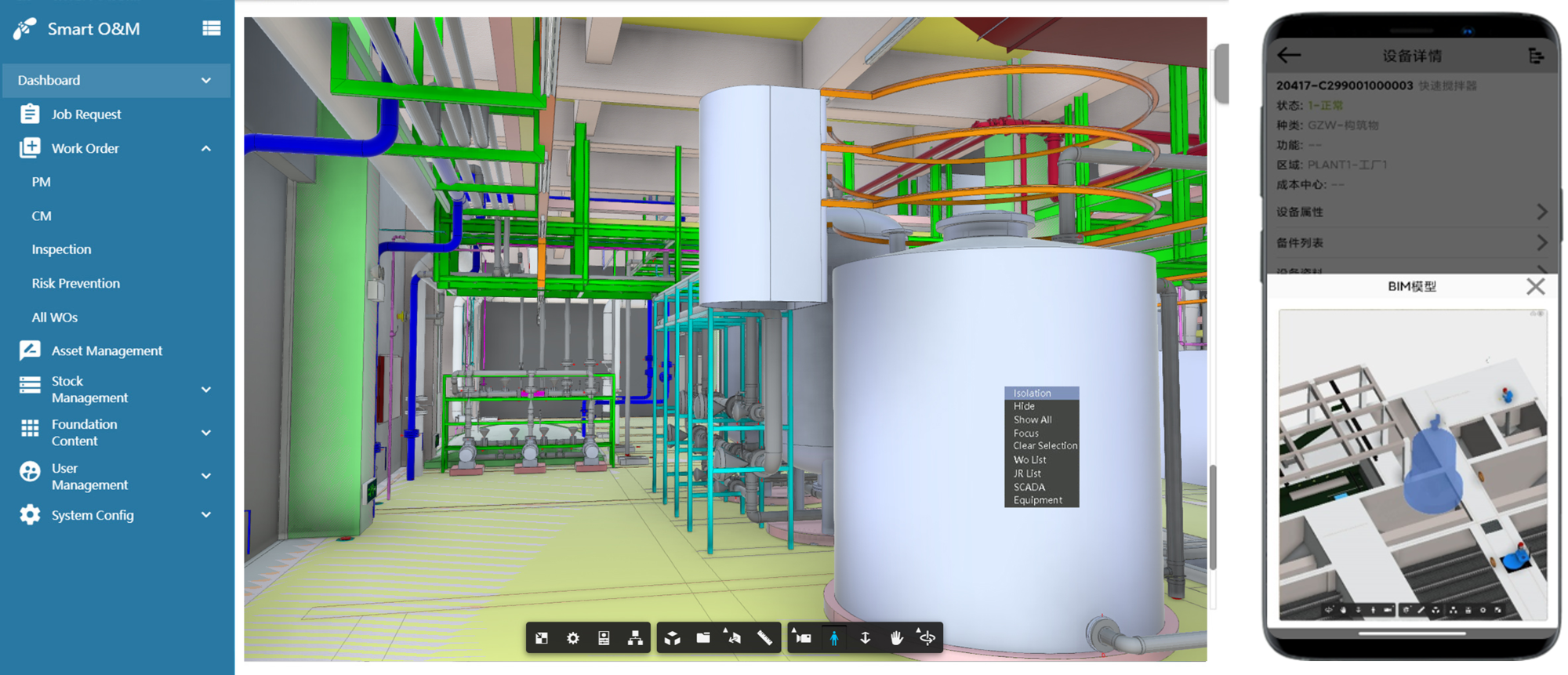
Even before 3D BIM became widespread, earlier versions of the bluebee® platform and the same method were already used to collect and structure O&M data during construction, across hundreds of sites in Asia and Africa. China served as a high-volume testbed, one of the world’s most intensive infrastructure markets, so the approach could be refined under real operating conditions. 3D BIM was integrated into the platform in 2013. The same solution is now delivered internationally for public infrastructure, utilities and buildings.
Three practical steps for owners and EPCs
- Audit existing or incoming models for usable O&M attributes (asset identification, spare parts, preventive plans) aligned with ISO 55000 thinking. Supplement what is missing.
- Make a BIM O&M data-preparation plan a tender requirement and involve an independent maintenance or asset consultant, not only the design or construction team.
- Choose a partner with a proven industrial CMMS and BIM implementation record, not a visualisation software reseller or a generic IT development firm.
Why talk to Bluebee Tech and Siveco China
- Pioneer of BIM for O&M, long before the regulatory mandates.
- Hundreds of references from construction to O&M, with or without 3D visualization.
- Proven bluebee® platform, not a demonstration viewer.
The difference between a digital ruin and a living asset is whether the model is connected to daily maintenance, asset and safety processes. If you have a BIM model approaching handover, or one that is already sitting unused, we can review whether it is actually usable for O&M and what it would take to make it so.
Contact us to discuss BIM for O&M solutions for your next project.