French entrepreneur shares two decades of insights from China’s Smart Water sector
French entrepreneur Bruno, founder of Siveco China and Bluebee Technologies, offered a detailed firsthand perspective on the evolution of digital operations and maintenance in the water industry during a recent international forum. With 26 years of experience in Chinese infrastructure — particularly water — Bruno traced his company’s journey from early challenges to global expansion, highlighting practical lessons on blending technology with operational realities.
Betting on China’s Water Boom
When Bruno established Siveco China in 2004, the local environmental market remained underdeveloped. International firms had limited presence, and water utilities showed little enthusiasm for advanced maintenance practices. Utilities often cited equipment redundancy, overcapacity, and a lack of skilled staff for IT systems or Western methods. Despite these initial difficulties, Bruno’s prediction of surging demand driven by rapid urbanization and industrialization proved accurate. As China’s water infrastructure expanded at scale, the need for professional maintenance and supporting digital tools grew significantly.
Core Principles Behind Smart O&M
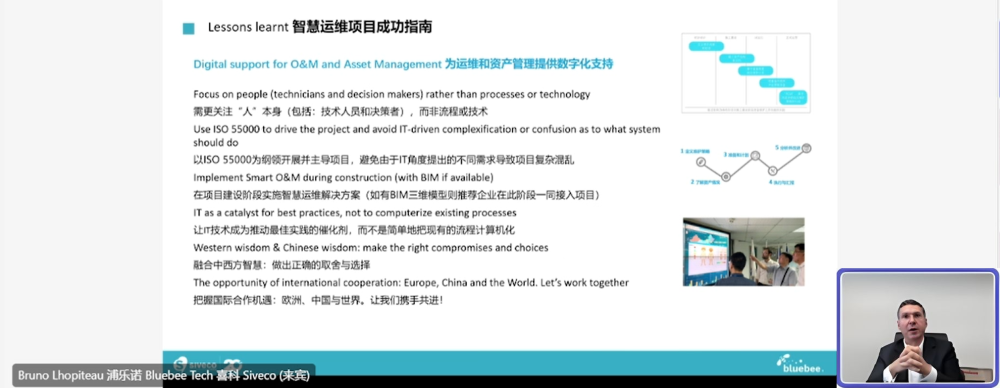
Siveco China developed its Smart O&M platform, known as bluebee®, which went beyond conventional maintenance management systems. The company emphasized a mobile-first design and focused on two foundational principles: integrating operations and maintenance considerations early in the construction phase to ensure smooth handover and readiness from day one, and applying the ISO 55000 asset management standard as a practical guide to align technology with real management needs.
Turning Western Wisdom Upside Down
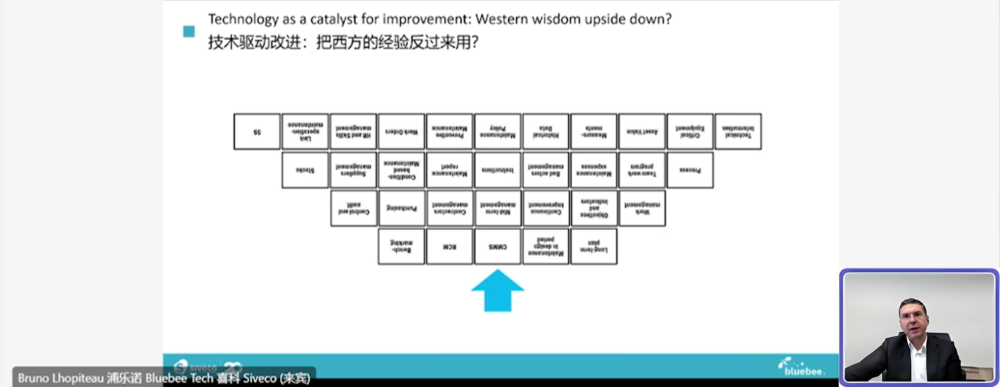
A central theme was the limitations of traditional Western consulting approaches in fast-evolving Asian contexts. Conventional advice often called for fully organizing processes and building organizational maturity before introducing technology. Bruno’s team found this sequential method ineffective amid rapid growth, changing regulations, and staff turnover. Instead, the company adopted the reverse strategy — deploying information technology as a catalyst to define, enforce, and instill best practices across all levels of the workforce. This approach, implemented through smartphone-based tools from the mid-2000s onward, helped accelerate organizational development while delivering immediate operational improvements.
Learning from the Smart Water Hype
The presentation also addressed the broader Smart Water wave that gained momentum in China, particularly after the COVID period. Widespread enthusiasm led to heavy investments in IoT, digital twins, and AI solutions, with many utilities and suppliers developing comprehensive platforms. Bruno described the familiar pattern of initial excitement followed by a period of adjustment and more realistic expectations. He noted that the current phase of learning and refinement has created opportunities for solutions that combine strong operations and maintenance fundamentals with practical digital capabilities.
Exporting the China Model
From its early years, Siveco China pursued international growth by partnering with Chinese EPC contractors on projects abroad, initially in power and later in water sectors across Asia, Africa, the Middle East, and beyond. The methodologies refined in China have transferred effectively to emerging markets, where utilities have readily adopted mobile and AI-enhanced tools. The company has also recently undertaken projects in Europe, indicating that operational needs are increasingly aligned across different regions.
A Bridge Between Worlds
Bruno presented his company as a distinctive bridge — a Western-founded enterprise that succeeded in China and has since evolved into a Chinese-based player exporting solutions and expertise. He stressed that effective Smart Water initiatives rely not just on technology but on deep domain knowledge, cultural adaptation, and collaborative approaches. As China shifts from being primarily a client and infrastructure builder to a provider of advanced solutions, new forms of international cooperation are emerging in the water sector.
In conclusion, Bruno highlighted the importance of partnership across the industry ecosystem — among utilities, contractors, consultants, and technology providers — to achieve lasting improvements in operations and maintenance. He invited further dialogue and offered to share presentation materials with interested participants.
Bruno’s account provided a grounded, experience-based view of digital transformation in the water sector, offering valuable perspectives for stakeholders navigating similar challenges worldwide.