Sound finance, reliable assets: extending SAP PM’s equipment management value with reliability at its core
Many enterprises that have already deployed the SAP PM module share a common assumption: if costs are properly accounted for and work orders flow smoothly, then equipment management is essentially in place. But practical experience shared by Siveco China at a recent webinar shows there is still a gap to close between getting the costs right and actually managing the equipment well. SAP PM’s design logic, centered on cost management with financial accounting as its core, is not opposed to the reliability-centered objectives of maintenance departments. The two have different emphases and can complement each other. Drawing on a presentation by Billy Cai, Operations Director at Siveco China, this article examines the management needs that arise from these differing priorities in practice and explores how to build value-added practices and a Smart O&M implementation path for SAP PM, guided by ISO 55000 and centered on equipment reliability.
(SAP is a registered trademark of SAP SE in Germany and other countries. This article reflects Siveco China’s project experience and is intended to discuss equipment management optimization paths; it is not an evaluation or endorsement of SAP products.)
The limits of SAP PM’s strengths: cost focus and reliability goals have different emphases
SAP PM is cost-centric, with financial accounting and work order flow at its core. Its work order system revolves around costs, spare parts consumption and cost settlement, and it delivers mature value in closing the financial cost loop. In some clients’ practices, a habit has taken hold: “no work order is opened unless costs are involved,” and the work order process is driven entirely by financial cost accounting.
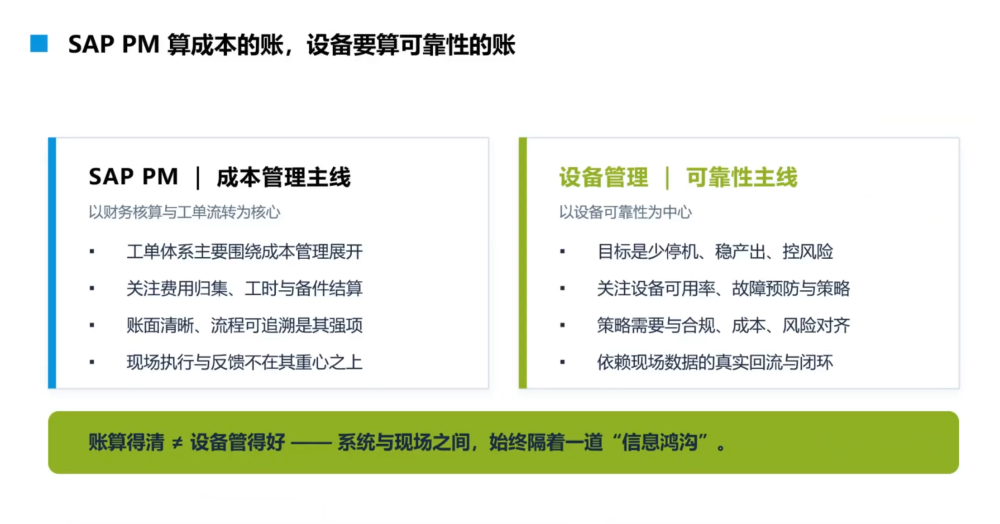
For equipment management, however, the management focus must also include reliability: reducing downtime, ensuring stable production, controlling safety risks, monitoring equipment availability, tracking failure statistics, developing preventive maintenance strategies and seeking the optimal balance among compliance, cost and risk, all of which depend on real field data feeding back into a closed loop. It is precisely this difference in emphasis between the “financial perspective” and the “reliability perspective” that leaves room for SAP PM to be extended further into equipment reliability management.
Five areas for expansion: a comprehensive diagnosis from strategy to analysis
- First, at the strategy level. Equipment management needs to find the best balance among cost, compliance and risk, rather than serving cost alone. Complementing SAP PM with an overall equipment management strategy is key to unlocking further value in many projects.
- Second, at the asset level. SAP PM often serves the fixed asset ledger of financial management, but the physical asset ledger and the financial ledger are two different concepts with entirely different levels of granularity. Finance may register and capitalize an entire unit or an entire project as a single fixed asset, whereas equipment management requires granularity refined down to the maintainable unit, so that failure statistics, preventive maintenance and inspections can be clearly defined.
- Third, at the planning level. Although preventive maintenance work and work orders are planned and generated in SAP PM, the results do not always flow back in a timely manner. There is still room to improve the flexibility of plan execution and tracking, and how planned spare parts and planned labor hours are reflected in released work orders.
- Fourth, at the execution level. Many customers rely on paper records: work orders are printed on paper forms and entered into the system again after field execution, resulting in duplicate entry. Data cannot flow back to the back office efficiently and in real time, and there is no mobile closed loop for receiving, executing and providing feedback at the work site.
- Fifth, at the analysis level. Most reports in SAP PM serve financial purposes. Analysis reports related to equipment maintenance management and failure statistics still need to be supplemented to better support reliability improvement.
A five-step approach to breakthrough: a closed-loop system guided by ISO 55000
In response to these expansion needs, Siveco China has built a five-step equipment management system based on ISO 55000, forming a complete closed loop from objectives to improvement:
- Objective alignment: define the equipment management and maintenance strategy, clarify what problems the system is expected to solve and achieve an effective balance among cost, risk and performance.
- Data standardization: clarify the management objects, including equipment structure, coding rules, criticality, spare parts and failure codes.
- Process standardization: develop standard SOPs and work instructions, covering preventive maintenance plans, corrective repair processes, overhaul management, lockout/tagout, work permits, spare parts procurement and various approvals.
- Execution and reporting: field personnel execute work orders and feed back data effectively, ensuring that all data is accurately consolidated.
- Statistical analysis: generate statistical analysis reports to support performance analysis and continuous improvement.
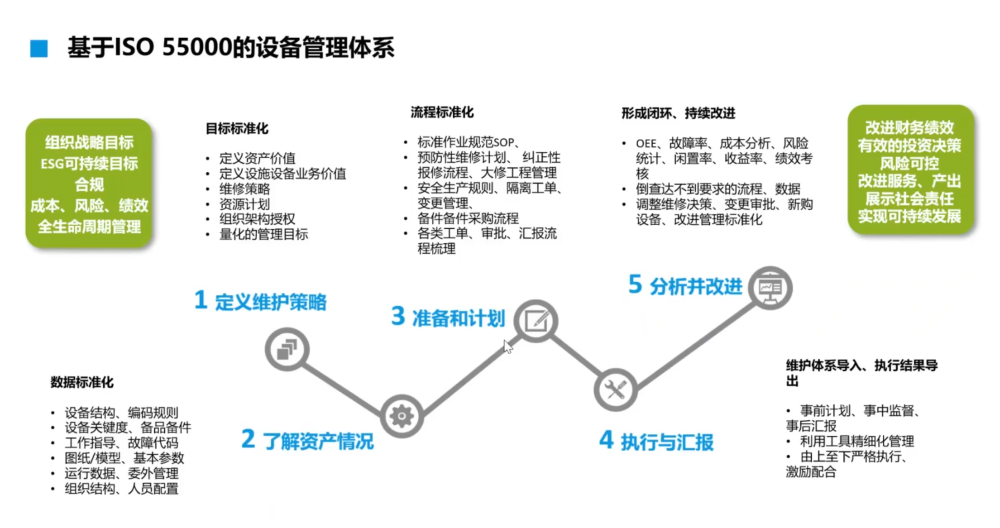
The core of this system is to make equipment reliability the foundation and center of management, complementing the financial cost loop of SAP PM.
Smart O&M implementation: complementary expansion through back-office systems, mobile apps and AI
Building on the five-step theoretical framework, Siveco China provides a complete Smart O&M solution covering Asset Management, ESG and operations and maintenance. Its scope extends from asset procurement requests, acceptance and capitalization, to asset information creation, spare parts management, asset structure trees, inventory checks, transfers and disposal, and further to failure and defect management, preventive maintenance, inspections, predictive maintenance, safety management and specialized equipment management (such as corrosion thickness measurement and lubrication) during the O&M phase. It can also integrate seamlessly with master data systems, finance, procurement, OA and DCS/SCADA.
Mobile is the key to a paperless closed loop. Since 2010, Siveco China has continuously invested in mobile solution R&D, aiming to bring frontline operators and maintenance personnel, who have long remained outside the equipment management system, into the system. The offline version, bluebee® Android, supports downloading work orders in no-network environments, executing and feeding back data on site, temporarily storing data in the phone database and automatically synchronizing once connected. The cross-platform version, bluebee® On, can be embedded in OA, DingTalk, WeCom or mini-programs, supporting dashboards, reports and charts, asset inventory checks, transfer and disposal requests, various types of work order management and spare parts scanning for inbound/outbound inventory, meeting the needs of different roles in multiple scenarios.
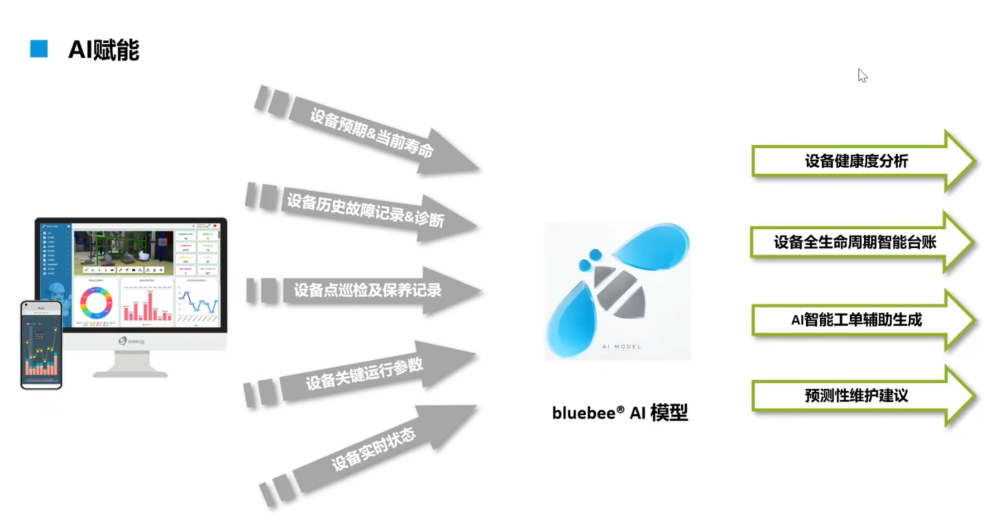
AI further strengthens reliability analysis. Over the past two years, Siveco China has been actively developing AI-related features, including equipment health analysis, a lifecycle-based intelligent asset register, predictive maintenance recommendations, AI-assisted smart work order generation and its proprietary bluebee® knowledge base model (with local deployment support). Unlike large-model algorithms that are primarily driven by sensor data, Siveco China relies more heavily on historical equipment failures, maintenance history, inspection and routine maintenance records, key operating parameters and real-time status to make more accurate judgments. For example, the system can generate a work order with one click based on the repair request description, symptom codes and photos, automatically populate fault causes, repair recommendations, safety tips, recommended spare parts replacements and lockout/tagout content, and extract historical experience from the knowledge base in a structured way and populate the corresponding fields of the work order, helping on-site teams prepare for work more accurately and conveniently.
Three steps to integration: from process mapping to a data closed loop
For enterprises already using SAP PM, Siveco China recommends a three-step approach to integration and expansion:
Step 1: Clarify business processes. First identify pain points and process breakpoints, map out maintenance strategies and key processes and determine which data needs to be connected and integrated.
Step 2: Technical integration. Taking work orders as an example: work order information generated in SAP PM is first synchronized to the bluebee® back-office system and then automatically displayed on the mobile side. Maintenance personnel execute and feed back on site through the mobile app, and the data is immediately returned to the back office and then transmitted back to SAP PM in real time via interfaces. It is important to emphasize that the mobile side does not connect directly to SAP PM; mobile app implementation is achieved through back-office-to-back-office system integration. This is the key point. Spare parts procurement, requisition requests, service procurement and other processes can also be effectively integrated with SAP.
Step 3: Overall implementation to form a closed loop. A complete feedback chain is formed from planning, execution and feedback to analysis and optimization. Dashboard reports, failure analysis reports and AI applications can be presented directly in the bluebee® system, supporting management teams in conducting more comprehensive and in-depth analysis. The data returned to SAP PM is mainly used for work order status closure and the financial cost loop; the two are complementary rather than a replacement.
It is worth mentioning that for enterprises that have not yet deployed SAP PM, overall equipment management can be achieved more directly and efficiently through the bluebee® solution, fully implementing the five-step approach. This has been validated in the vast majority of clients that do not use the PM module. Integration with other SAP modules is also supported, in particular MM for materials and procurement flows, and FI/CO for cost settlement.
Conclusion
SAP PM delivers mature value in getting costs right, but equipment management must also answer the question of managing equipment well. Guided by ISO 55000 and centered on equipment reliability, through the five-step system, the mobile paperless closed loop, AI-powered intelligent analysis and the three-step system integration approach, enterprises can retain the value of SAP PM’s financial cost loop while addressing the five expansion needs in strategy, asset, planning, execution and analysis, building an equipment asset management system that truly places reliability at its core. This is precisely the value-added practice path advocated by Siveco China’s Smart O&M solutions.
To learn more about SAP PM value-added practices and Smart O&M implementation case studies, please contact the Siveco China team.